
Writing is one of the hardest subjects to teach, but my favorite because there are so many ways you can teach it. Some people like to follow a program, but for those who like to be creative, following the basic format for Writing Workshop can give you a framework and freedom to meet the needs of your students. The Writing Workshop framework can be used to teach writing in all grade levels and has been around for many decades.
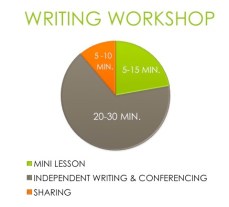 In my last post I wrote about the last stage in Workshop, Author’s Chair. The school where I work is currently focusing on improving our writing program. A few months ago I was asked to create and provide a short training to introduce the Writing Workshop format to my colleagues. I thought that this week I could share some great resources and a general understanding of each stage of Workshop: Mini lesson, Independent/Guided Writing, Conferencing, and Sharing. I hope you enjoy and are able to take away something to add to your writing instruction!
MINI LESSON There are three types of mini lessons. A mini lesson should focus on procedures, grammar skills, or writing craft/technique. Mini lessons on procedures and organization of Writing Workshop in your classroom usually take place at the beginning of the year when students are learning routines, but they can be revisited throughout the year as needed. Mini lessons that focus on writing craft and grammar skills are where the writing standards are taught and should be revisited whenever needed. These lessons are called mini lessons for a reason; they should run about 5-10 minutes in lower elementary, and should never exceed 15 minutes in upper elementary. I will go into more detail in a future posting; the overall key here is to keep the lesson short and to the point so that students understand what they should be focusing on when they practice their writing.
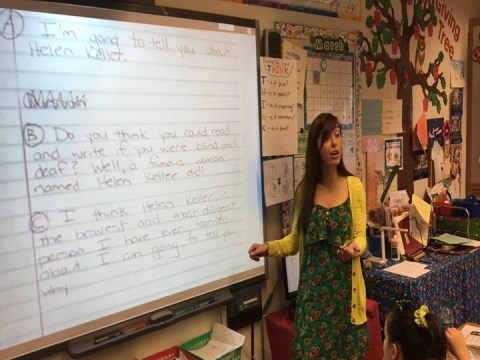
INDEPENDENT WRITING The next stage of Workshop is where students practice the skill(s) that have been taught in the mini lesson. Writing time can take place independently or as a class (guided writing).
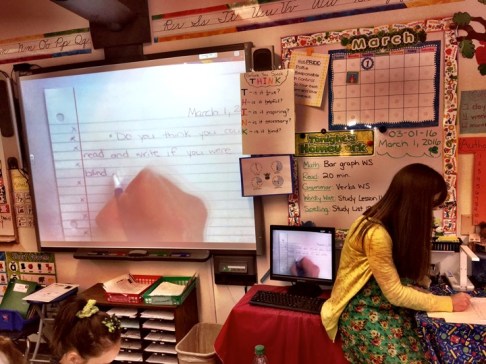
Students write to explore a concept from the mini lesson and possibly work on a current writing goal. Students also are working on some specific part of the writing process (brainstorming, rough drafting, revising, editing, publishing). When students write independently, it allows the teacher to walk around and conference with individual or small groups. I will provide some more management ideas in a future post!
CONFERENCING This stage takes place simultaneously with independent writing time. This is a very important stage and one of the hardest for teachers to manage due to the complexity of it. Conferencing can be a scheduled meeting to check-in or prepare a student to publish, or to work with a multiple students, known as a strategy group, to help differentiate skills 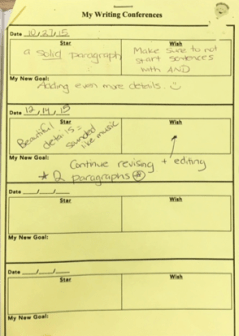 needed to remediate or excel. It can also be a student requested meeting that day. I try to spend the beginning of each independent writing time walking around and meeting with students who need help getting started, and then sit down to begin my scheduled conferences. When it is a scheduled meeting, I make sure to focus on a positive of their writing (STAR) and something that we can work on together to make their pieces stronger (WISH). I record this in the back of the Writer’s Notebook for them to be able to refer back to. I have found that using such resources like the 6 Traits of Writing help guide my conferences.
SHARING The last stage is often left off (I’m guilty!), but is very important. Many teachers call this “Author’s Chair,” and it is a favorite time for students. During sharing, students read their writing in front of their classmates, however, there is more going on here than a reading/listening relationship. After a student has shared their piece, their classmates analyze what they have just heard and provide positive feedback in order to help that writer. When they know that others will be reading or listening to what they write, they tend to be more motivated and take ownership of what they are doing. Author’s Chair provides students with an important audience, their peers. In addition, it provides another time for the class to lead a student discussion about writing techniques. Please read my last post, Managing Author’s Chair, for more details as to why it is important and some quick tips for making sharing time valuable to your students.
Please visit my TpT store to download the free presentation I created for an overview and links to great resources!
I hope this post has made lightbulbs go off in your teacher brain! I appreciate any feedback and/or reflections you may have because…if you give a teacher an idea…..
Warmly, Ashley “If You Give a Teacher An Idea” Creator & Author
 If You Give a Teacher an Idea...